The next access challenge is not opening more doors into care. It is keeping young people supported after they walk through one.
TL;DR: Screening identified the crisis. Referrals exposed the bottleneck. Even strong integrated behavioral health models cannot fully support young people during waits, between visits, after hours, or when they are not ready to engage with traditional care. As youth increasingly turn to digital and AI tools on their own, health systems need a safer answer: a human-led, AI-supported model that is accountable, scalable, and connected to the clinical team.
The system breaks down at 11:47 p.m., when an adolescent is alone, overwhelmed, and unable or unwilling to call the clinic.
Young people don’t struggle on a schedule. Behavioral health quality initiatives have helped systems screen for needs, identify risk, and integrate behavioral health into primary care. That progress matters. But identification is not support, and the moment of need rarely lines up with an open clinic, an available appointment, or a young person who is ready to talk.
We see this from two vantage points. One of us leads behavioral health for a nationally recognized pediatric system. The other leads a company built to support young people directly. We have reached the same conclusion. Youth behavioral health providers cannot hire fast enough to close a gap this large.
At Akron Children’s, roughly one in four pediatric primary care visits involves a behavioral health concern. Over the past year, more than 4,500 youth were seen in the emergency department with a behavioral health concern. Even with an integrated behavioral health model, the average wait to see a therapist is still more than two months.
Akron Children’s has spent years building TABBICAT, which stands for Triage, Assessment, Brief Behavioral Interventions, Care Coordination, and Tracking. The model integrates behavioral health into pediatric primary care, meeting children and families where they already show up and helping patients reach the right level of care at the right time.
Even the best integrated models have edges. Waitlists stretch. Clinics close. Not every young person is ready to talk during a visit. Many are navigating stress, grief, peer conflict, family dynamics, or relationship challenges that are too significant to ignore but not acute enough for specialty care. Others need developmentally appropriate support but do not fit neatly inside traditional pediatric workflows.
Sonar is built for those edges: 24/7 wellbeing coaching through a secure, text-based platform, delivered by trained human coaches and supported by AI behind the scenes.
For Akron Children’s, Sonar creates an immediate support option after a screen, while young people wait for care, or between visits. It keeps adolescents connected until they are ready for the next step and can extend that same support to transition-age young adults up to 26 who remain tied to pediatric care teams but are harder to reach through traditional workflows.
Built for the young person who won’t pick up the phone
This support has to work outside the clinic. Sonar’s data confirms the 11:47 p.m. reality: 77 percent of conversations happen late at night or early in the morning. But timing is only half the story. This generation grew up texting. They often process hard feelings in the same place they manage much of their lives: on a screen, in writing, and on their own terms. Sonar meets them there, not as an appointment, a waiting room, or a form, but as a conversation in the language they already use.
Here’s what that can look like at 11:58 p.m. on a Tuesday:
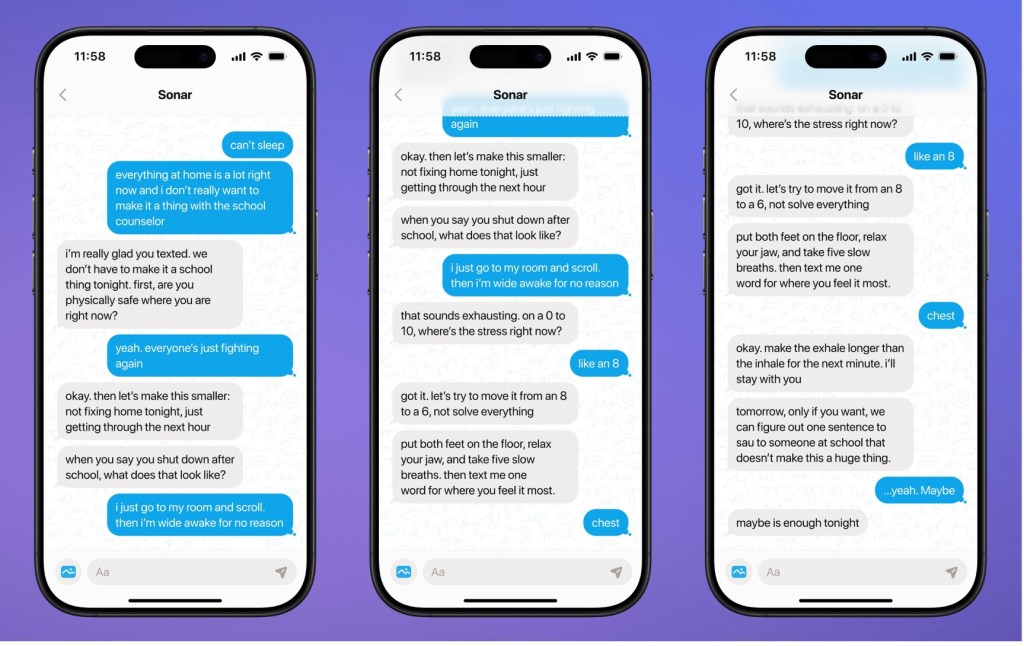
Illustrative exchange based on real Sonar conversations; details changed to protect privacy.
That “maybe” is the point. It is a young person who would not have talked to a therapist taking a first step toward support. Families often notice that shift first. As one parent told us:
“My kid refuses to see a therapist. But they’d be willing to start with this.”
For many families, the first breakthrough is not “I’m ready for therapy.” It is “I’ll try this.” An empty therapy chair helps no one.
For Akron Children’s, Sonar is not another front door or a disconnected digital tool. It is connective tissue around existing pathways, helping the care team stay aware of young people during windows when they would otherwise be invisible.
The human makes it safe. The technology makes it scalable.
In behavioral health, AI should not be the relationship. It should be the infrastructure beneath a human relationship. Sonar is human-led and AI-supported by design, and the order of those words matters. A trained Wellbeing Coach is responsible for every message a young person receives. AI works behind the scenes to help coaches maintain context, recall prior conversations, draft responses, and surface risk, so each coach can show up with more consistency and safety.
That distinction matters because young people are already using AI for support. A 2025 Common Sense Media survey found that 72 percent of teens had used AI companions, with nearly a third turning to AI instead of a real person for serious conversations. The question for systems is not whether young people will seek digital support. They already do. The question is whether that support will remain outside the care model or become human-led, accountable, and connected to care.
In May 2026, Common Sense Media’s Youth AI Safety Institute stress-tested five AI mental health products across more than 3,100 exchanges with youth test accounts. Sonar received a “Minimal risk” rating, the highest rating in the category, with the report citing human oversight, institutional accountability, and crisis-escalation pathways. The report called rapid human follow-up “the standard that every product in this space should be held to.” When signs of crisis appear, Sonar follows escalation protocols defined jointly with Akron Children’s, connecting the young person quickly to the right clinical help.
Sonar is also measuring this model. Pilot study results outside Akron Children’s are encouraging: young people using Sonar reported meaningful improvement on validated self-report measures by Week 4, and Sonar maintained full adherence to defined crisis-escalation protocols across hundreds of cases. In the coming months, Akron Children’s and Sonar will launch a formal research study evaluating how Sonar functions as a support layer within TABBICAT, including engagement, distress, self-efficacy, and care-team visibility when concerns escalate. We will share what we find, including where the model needs to improve.
How to build this responsibly
For pediatric and behavioral health leaders facing the same pressure, the lesson is not to adopt another tool. It is to redesign for the unsupported spaces around care.
Start with four questions: After a positive screen, where does the young person go tonight? During a waitlist, who is paying attention? Between visits, what should trigger escalation? When needs are lower acuity, how do you keep scarce clinicians focused on the young people who need them most?
The goal is not to replace clinical care. It is to extend trusted systems into the hours, waits, and transition points where young people are already struggling.
For organizations asking what happens after a positive screen, while a young person waits for care, or at 11:47 p.m., this is the next layer pediatric behavioral health has to build.
To learn more about the Akron Children’s and Sonar partnership, read the partnership announcement here.
For more information, contact:
Holly Pupino, hpupino@akronchildrens.org
Drew Barvir, drew@sonarmentalhealth.com
At the Becker's Fall Behavioral Health Summit, taking place November 4–5 in Chicago, behavioral health leaders and executives will explore strategies for expanding access to care, integrating services, addressing workforce challenges and leveraging innovation to improve outcomes across the behavioral health continuum. Apply for complimentary registration now.